






You've probably had this experience without thinking too hard about it: You're scrolling through your social media feed, you pass a sponsored post, and within about half a second something tells you the image was generated by AI and the caption was written by ChatGPT. You can't always tell right away, but something just feels slightly off. Maybe it’s too perfect? The lighting is slightly off? Maybe the copy has that confident, slightly empty rhythm with 16 em-dashes in a single paragraph that screams nobody actually proofread it before posting. The icons and typography look exactly like the three other companies who you’ve seen posted earlier that day. Before you've even registered the company's name, a verdict forms in the back of your mind. Lazy. Or cheap. Or just not really trying.
That reaction takes a fraction of a second, and it sticks.
It isn't only happening on social ads. Look at flyers, landing pages, the websites for entire industries, and you'll start to see the same patterns showing up everywhere. Dark navy hero sections. Rounded white cards floating over light gray backgrounds. A soft gradient blob drifting off the edge of the screen for no clear reason. A headline promising to help you do something "at scale." A stock photo of a confident professional with their arms crossed in a doorway.
Nobody briefed an agency and asked them to look exactly like the competition. Nobody chose this on purpose. And yet entire industries have landed on a visual language so similar that you could swap the logos between competitors and most people would never even catch it.
Having been a designer for 15+ years, I have watched plenty of trends come and go, including the whole stretch before AI tools went mainstream. With a foundation in business alongside design, I've never been able to look at a brand and only see the design. I'm always reading it for what it's supposed to do for the company behind it, which is really the difference between asking whether something looks good and asking whether it actually works.
So when I watch this wave of identical, AI-assembled branding roll across every feed and website, I find it genuinely fascinating, and a little bit cringeworthy, right up until I think about what it actually costs the companies stuck inside it. Because this isn't a style problem or a taste problem, but a problem of approach. And the reason it keeps getting worse comes down to how AI design tools work, and what they happen to be good at versus what they are not.
What AI Design Tools Are Actually Doing
People tend to assume AI tools are generating something new. They're not, really. They're averaging things that already exist.
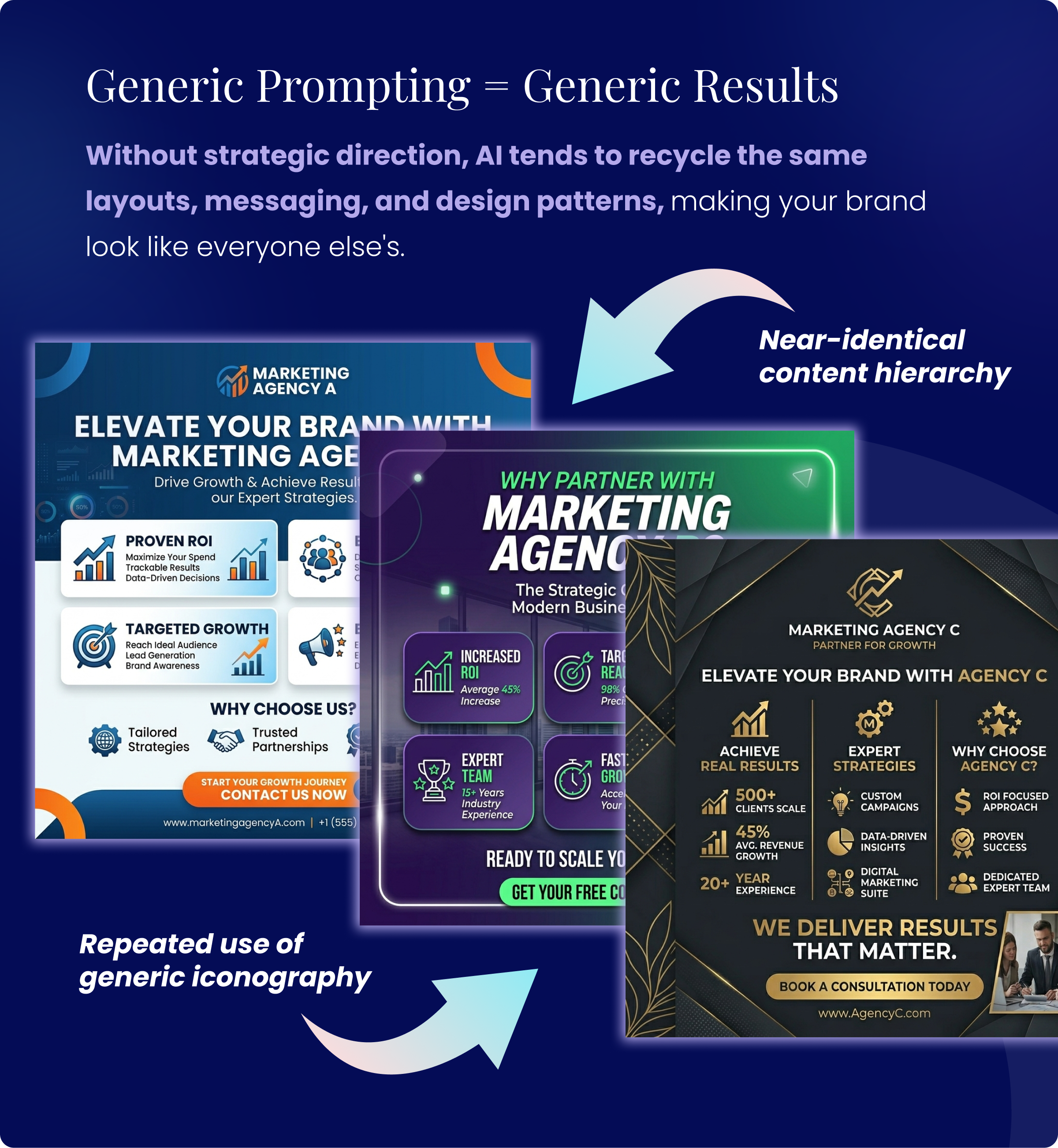
When you drop a prompt into a logo generator, spin up a social ad in a template tool, or ask AI for a ‘professional B2B tech brand,’ the model isn't considering your company, your buyers, or the dozen competitors you're trying to stand apart from. It scans millions of existing designs, finds the statistical middle of what ‘B2B professional’ usually looks like, and hands you back the most familiar version of that. Clean. Competent. And nearly identical to what everyone else gets when they type something similar.
A 2025 study presented at the ACM Conference on Fairness, Accountability, and Transparency analyzed more than six-million prompts on a popular AI image platform and found that as more people used the tools, their prompts and the images that came out of them grew measurably more alike. The more popular a tag or descriptor became, the more everyone leaned on it, and the less varied the results got.
A separate 2025 study published in Computers in Human Behavior: Artificial Humans looked at writing rather than images and reached the same conclusion: the wider the adoption of the same AI model, the more the collective output converges. The models reward the middle of the road, not its edges. The specific, the unexpected, the genuinely distinctive material is the first thing to get smoothed away.
The result is that every company in your category that has touched these tools over the past couple of years keeps arriving at the same look. The same visuals keep repeating themselves on the websites, then the social ads, then the trade show flyers, then the sales one-pagers, until the whole brand is just slightly blurry versions of everyone else's. And when buyers can't tell you apart visually, they usually fall back on the one variable that's left to compare: price.
Your Buyers Feel It, Even If They Never Say It
This is the part that turns a design conversation into a revenue one.
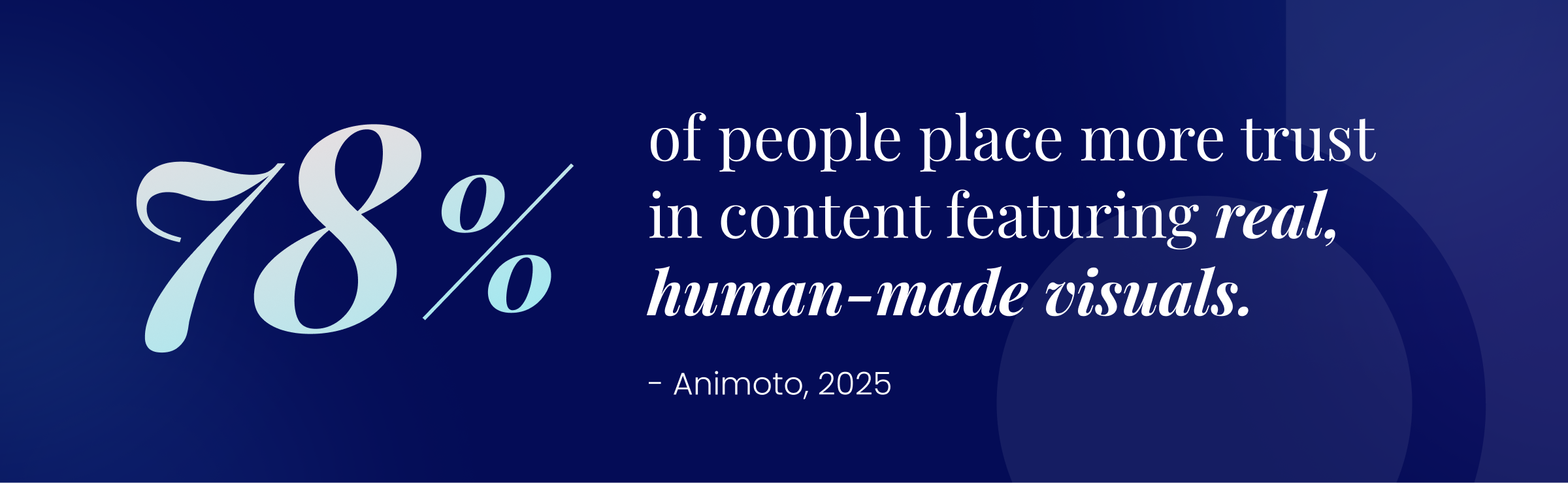
According to December 2025 data from Klaviyo and Datalily, 31% of consumers say visible AI-generated marketing content makes them trust a brand less. Only seven percent say it makes them trust a brand more. A 2025 study by Animoto found that 78% of people place more trust in content featuring real, human-made visuals than in AI-generated alternatives.
Nobody is consciously sitting there thinking, ‘that logo looks AI-generated.’ It's quieter than that, and faster. It's the same half-second judgment from the social feed I mentioned above, the one that decides a company is lazy before you've even read its name. Everything is technically right, and yet something underneath it reads as hollow.
For B2B companies in particular, where trust is often the real deciding factor in a purchase, that faint sense of something being off does more damage than most marketing teams give it credit for. It's worth remembering that the people forming those snap judgments aren't only consumers scrolling for fun. They're also the buyers, the procurement leads and the executives deciding whether your company is worth a meeting.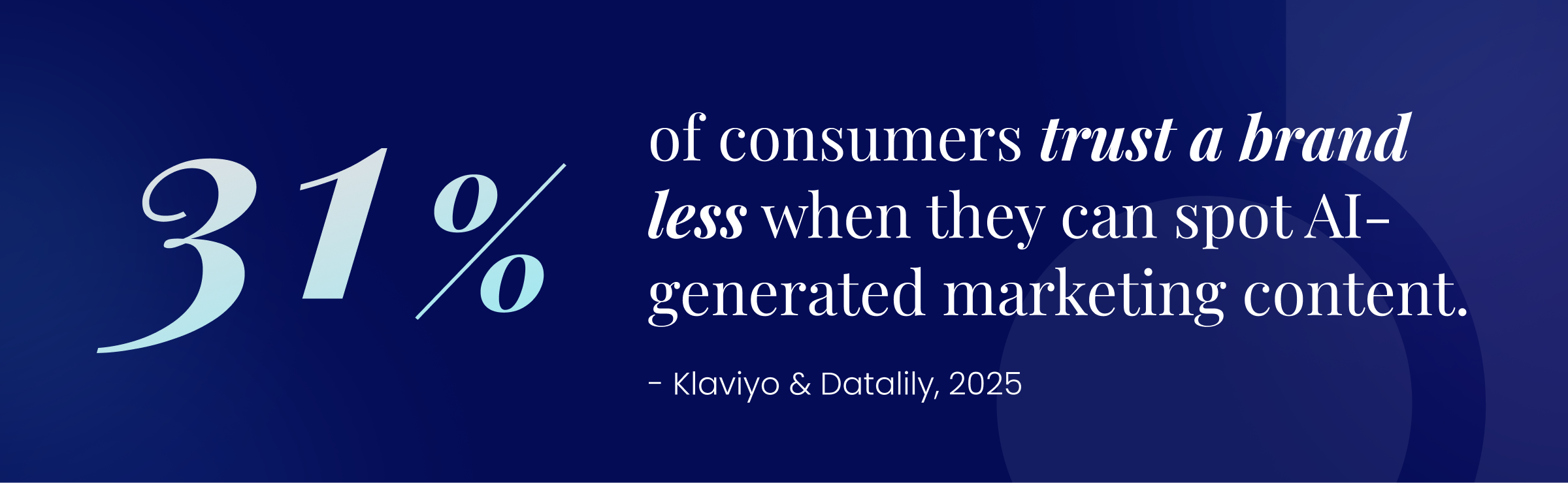
The Tools Aren't the Problem
AI is excellent at getting to early concepts quickly, exploring color combinations, generating variations and moving the production side of a project along at a pace that wasn't realistic a few years ago. As a designer, I can build five solid directions in the time it once took me to develop two. The problem is never the tool. The problem starts when the tool becomes the one making all of the decisions.
What AI doesn't and can't know is the stuff that actually makes a brand work. It doesn't know that your buyers in heavy manufacturing get suspicious of anything that looks like a startup pitch deck. It doesn't know that your three closest competitors just refreshed into nearly identical color palettes, which means you need to move away from that territory rather than toward it. It doesn't know that the thing your best customers say when they refer you has nothing to do with your service list and everything to do with how your people show up, and that this personality has to live somewhere in the brand. It doesn't know that your identity has to hold together at a trade show booth just as well as it does on a homepage, which takes more structure than ‘looks nice on a screen.’
A prompt won’t and can't carry any of that. A real strategy conversation can.
Two Companies, One Decision
Let’s see what this looks like in practice. Imagine two mid-market industrial companies refreshing their websites around the same time. Both have a deadline, both have a budget and both decide to use AI to move faster. The difference is in the order they do things.
The first company opens the tools on day one. They run their name through a logo generator, pull a handful of AI-generated images, and let the software make the calls. They land on something clean and modern in about six weeks and ship it. A standard layout, grid of service cards, the word "solutions" sitting on the homepage four separate times. It looks professional. It also looks like most of its competitors, because the tools handed everyone the same starting point and nobody steered away from it. The AI did the thinking, and the thinking came out average.
The second company starts somewhere else entirely. Before anyone opens a single tool, a designer sits down with the sales team and asks a deceptively simple question: "What do your best customers say when they recommend you to someone else?"
The answer, almost every time, is some version of the same thing: They actually understand our world.
That one sentence becomes the brief. Now the AI tools get used, and used heavily, but they're working toward something specific instead of guessing. The team uses AI to explore color directions and lands on the company's own deep orange, a color nobody else in the space is using. They use it to draft and refine dozens of headline options, then sharpen the best ones into copy that sounds like someone who has actually walked through the doors of the company. They lean on it to mock up layouts in hours instead of days. The difference is that a human decided what the brand needed to say first, and the AI helped say it faster. The photography is the one place they don't automate, real shots from actual job sites, because that is the detail buyers feel instantly.
Same tools. Same general timeline. One company let AI build a website. The other used AI to build a brand.
12 months later, the first company is back in the design conversation, trying to figure out why the site isn't bringing in leads and quietly wondering if the problem is SEO. The second company's sales team is pasting the website link into outreach emails, because for once it actually sounds like them. Same technology sat on both desks. Only one of them pointed it in a direction first. AI is a fantastic tool if you have strategy behind it, not let it replace the strategy for you.
There's a Search Angle Worth Knowing About
This matters even if the design side hasn't fully clicked yet.
When a potential buyer types a question into ChatGPT (or any other AI model) asking which companies they should look at in your category, the AI isn't simply returning a list of names. It's pulling from whatever it can find that's specific, consistent, and credible about each brand. A company that looks and sounds like everyone else gives those systems almost nothing to work with. No distinctive signal, no clear point of view worth surfacing to the person asking.
The brands that get named in AI-generated answers tend to be the ones with something coherent to say across all of their channels. That isn't luck. It's the downstream effect of being built with intent rather than assembled from defaults.
AI tools are getting very good at producing volume. They are not getting better at building meaningful content genuinely influential to setting you apart in the industry. Those are two different things, and the companies that treat them as the same are the ones quietly losing ground.
What Strategy-Led Design Actually Looks Like
Here's something my clients are sometimes surprised to hear me say. When I start a brand project, I'm not thinking about what it should look like yet. Not even a little.
I'm trying to figure out what's actually true about the company first. What do they do better than anyone else? Who are the customers that love them, and what is it those customers can't get anywhere else? What does this company quietly believe that none of its competitors would ever put on a homepage?
That last question is usually where the good stuff hides. Every strong brand I've ever worked on had a point of view that felt a little risky to commit to, and that's exactly why it worked. Playing it safe is how you end up looking like everyone else.
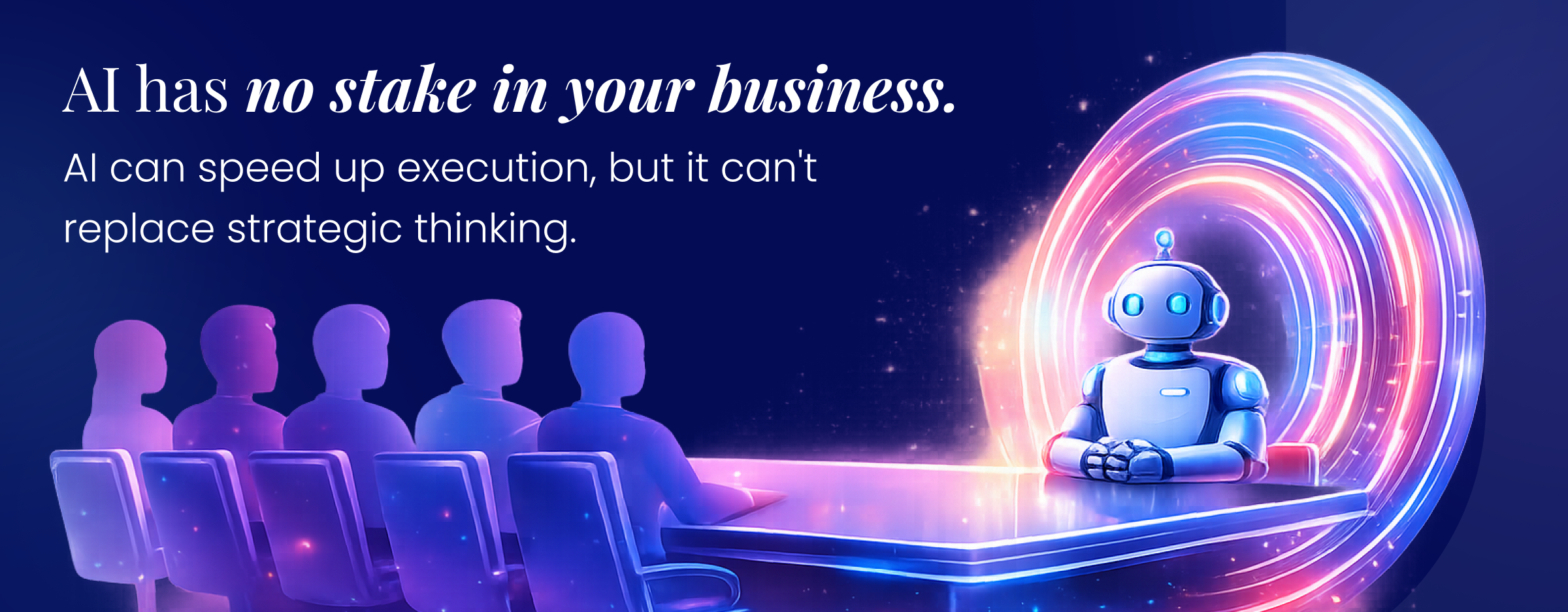
This is the part AI simply cannot do for you, and it's worth being clear about why. AI has no stake in your business.
It has never sat across from your customers, never lost a deal it should have won, never felt the specific frustration your product was built to solve. It can generate a thousand polished options, but it cannot tell you which one is true, because truth about your company isn't in the training data. It's in your head, your team's experience and your customers' words.
Get that part right, and everything downstream gets easier. The colors, the type, the photography, the layout, all of it finally has something to be about. That's also what makes a brand hold together when it shows up somewhere new, on a trade show banner, a pitch deck, a billboard nobody planned for. Nobody remembers the company with the dark blue hero and the wandering gradient blob. People remember the brand that felt like it was made by people who actually understood their world.
AI pulls everything toward the average. Good design starts by deciding, on purpose, not to land there.
Where Kuno Fits Into This
We've fully embraced AI, because it isn't a passing trend or a tool we tolerate. It's the future, and it's already reshaping the present. It's how people search, how they research, how they decide what's worth their attention. For a lot of buyers, AI has quietly become the new Google.
Businesses that learn to work with it now are setting themselves up to lead. We see AI as one of the most powerful advantages our clients have access to right now, and we've built our approach around helping them use it to its full potential.
That means AI shows up in nearly everything we do. It speeds up keyword research and content production. It lets us explore design directions in an afternoon that used to take a week. It surfaces patterns in data, helps us draft and test faster, and clears away the busywork so our time goes toward the thinking that actually moves a client forward. The efficiency is real, and we lean on it every day.
But here's the part that matters, and the part most people skip. The same tools that save you time will hand you the exact same output they're handing thousands of other companies, unless someone is steering them with a plan. Left on autopilot, AI doesn't help you stand out. It quietly files you in with everyone else. Embracing AI and embracing it strategically are two very different things, and only one of them can truly effectively grow a business.
So we point it in a direction first. That's the foundation of our brand experience services: the human work up front, understanding the business, the buyers, the competition, and what the brand genuinely needs to say to win. Once that foundation is set, AI becomes an accelerant for building on it. That's the whole value of a team that gets both sides. Strategy and creative direction lead, AI does the heavy lifting, and what comes out is a brand that holds its own in search, in sales conversations, on a website, and anywhere else a buyer runs into it for the first time. You get the speed of AI and the kind of distinctiveness that only comes from people who know exactly what they're building and why.
Kuno's Brand Experience team helps B2B & B2C companies build visual identities grounded in strategy rather than generic AI outputs. If that sounds like a conversation worth having, we're easy to reach.
Skyler Haines