






Somewhere in your company right now, a piece of content is being generated by AI that is technically correct, broadly on-message and somehow still doesn't sound like your brand. A sales rep sends it without thinking twice. A prospect reads it and feels something is off, but can't name what. The piece performs, or doesn't and the team moves on.
The instinct is to fix the prompt. The better question is why the prompt could not produce work with brand fidelity in the first place.
For most companies, the answer is they have never defined their brand with the specificity an automated system requires. They have a tagline. They have a visual standard. They have a handful of adjectives in an onboarding deck. What they lack is brand fidelity: brand expression, verbal and visual, that stays recognizably itself across every surface where the brand appears, including the ones now generated by AI. In a moment when an enormous share of brand expression is being assisted, drafted or fully produced by systems that lack judgment, that gap stops being cosmetic. It becomes structural.
This is why brand has become the precondition for AI-era fidelity.
AI Doesn't Create Brand. It Amplifies It.
AI does not create brand. It amplifies whatever brand definition you give it. Simple to state; sitting with the implications is what makes it uncomfortable.
If your brand is loosely defined, AI will produce content that is loosely on-brand at a scale you have never operated at before. An AI-drafted thought leadership post that hedges where the brand has historically been confident. Outbound sequences, generated by AI, that hit every messaging pillar and still read like every other vendor in the inbox. A support chatbot that lands a few degrees more casual than the rest of the company's voice. AI-generated pitch decks that populate the brand's templates with imagery and typography the brand has never used. Each one is plausible. Each one is defensible. Each one drifts in a slightly different direction. The aggregate effect, read across surfaces by a prospect or a customer, is dissonance. And dissonance at scale reads as inauthenticity.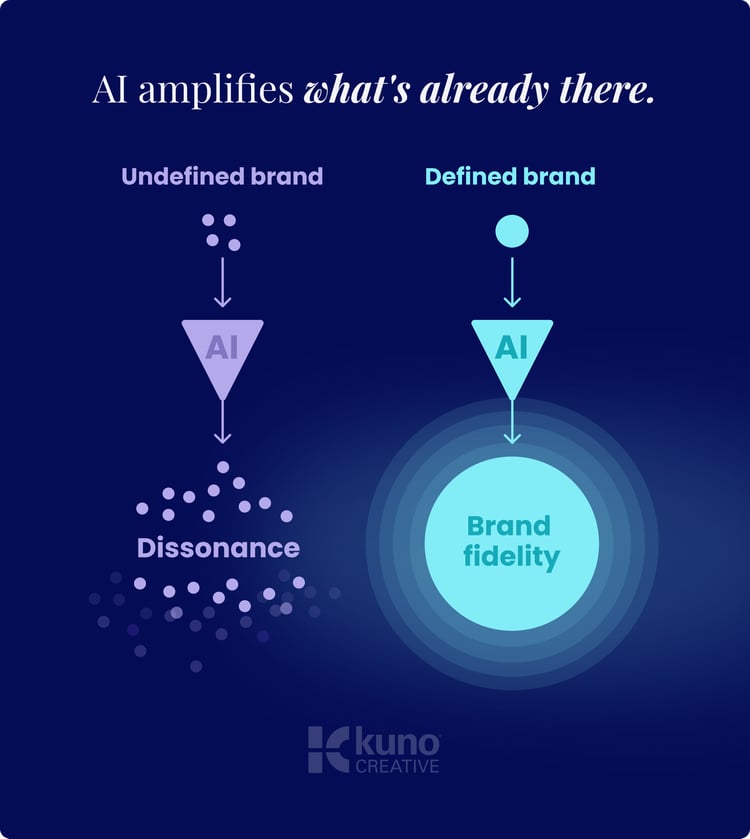
If your brand is tightly defined across identity, position, posture, point of view and relationship to the audience, AI will produce work that recognizably belongs to that brand across the same scale. That recognizability is brand fidelity in practice. Different surfaces, same voice. Different channels, same argument. Different formats, same underlying claim about who the company is and what it cares about.
The technology is the same in both cases. The output is not.
The New Bar Most Brands Haven't Met
For most B2B companies, the working definition of "well-defined brand" has been generous, if for no other reason than it had to be. Brand work, in practice, has been a small number of human practitioners holding the line through judgment. The CMO catches the draft that sounds wrong. The editor flags the headline that doesn't sit right. The designer rejects the layout that contradicts the system. The senior writer reshapes the awkward sentence. Different roles, same posture: judgment, applied in review. The whole system has run on tacit knowledge: the kind of pattern recognition that lives in practitioners' heads and travels by example.
AI dissolves that arrangement. The humans are still there. What changes is the surface area, which now expands faster than humans can review it. The same handful of practitioners who could catch ten drafts a week now sees a thousand outputs touched by the brand and reviewed by no one with comparable judgment. The tacit layer is no longer sufficient. What was implicit has to be made explicit.
The structural shift has a name. Big-bet marketing is giving way to continuous marketing. Big bets concentrated brand work into a few high-stakes campaigns a year, all of which the people who owned the brand could review. Continuous marketing distributes the work across dozens of teams and hundreds of outputs on an always-on cadence. AI is what makes that cadence sustainable and what pushes it past the point where any review system built on tacit judgment can hold.
This is the work most brands have not yet done. They've had little structural pressure to do it. The pressure is here now.
A well-defined brand sustains fidelity without you in the room.
Why Dissonance at Scale Reads as Dishonesty
Audiences are increasingly fluent in the textures of brand expression, even when they can't name what they're noticing. This is tacit knowledge from the other side of the brand. Practitioners hold it when they review work. Audiences hold it when they encounter it. The expectation, formed implicitly, is that the work will cohere. All the surfaces a company shows up on should read like the same company.
When they don't, the audience doesn't conclude that the company's AI tools are miscalibrated. They conclude something more fundamental: that the company hasn't decided what it stands for. A coherent brand reads as a company that has answered a question about itself. An incoherent one reads as a company still working it out in public. And working it out in public reads, in the current climate, as not being honest about what you are.
Some teams started calling this pattern voice drift: the slow divergence of brand expression across surfaces no one reviews as a system. Regardless of whatever you call it, the line between inconsistency and inauthenticity has narrowed considerably.
This is the cost most companies will absorb before they recognize what they're absorbing. Voice drift, given enough surfaces and enough time, accumulates into something larger: trust erosion. Trust erosion is rarely loud. It shows up as a slow softening of the response curve. Pipeline gets a little harder to fill. Deals take a little longer to close. Sales reps spend a little more time explaining the company in their own words because the company's own words don't carry. The numbers move, but the diagnosis isn't obvious from the numbers.
Brand Is No Longer an Input. It's a Precondition.
Part of why the diagnosis isn't obvious is that the common framing positions brand as an input to revenue, a contributor to a conversion system valued for the lift it produces. This framing has always been incomplete and the AI moment makes its incompleteness visible.
Brand is not an input to AI-era marketing the way creative is an input to a campaign. It is the precondition that determines whether AI is an accelerant or a liability. Without a defined brand, scale becomes risk. With a defined brand, scale becomes leverage. The same investment in AI produces different outcomes for two companies because the brand definitions underneath are different.
This reframe matters because it changes what brand work is for. The job is upstream of revenue. Brand work produces the underlying clarity that allows every other motion, revenue and otherwise, to operate without distorting the company along the way.
What separates companies that will pull ahead in the next few years won't be the sophistication of their AI stack. It will be whether their brand definitions were articulate enough to make the stack worth running. The work that looked like a luxury in 2022 is the work that determines, in 2026, whether the new tools compound a company's advantage or its dissonance.
That is a brand question. It has always been a brand question. The AI moment has only made the cost of not answering it more legible.


Daniel Ulichney