






If you’re using AI for marketing and content, you might be doing it wrong.
Marketing has always been about timing, clarity and human connection. But the speed of modern campaigns and the complexity of managing multiple data streams have left many teams stretched thin.
Enter artificial intelligence, a technology that makes many nervous even as it increases productivity by up to 15%. While off-the-shelf AI marketing tools open new doors to greater production, these tools still can't fully understand what makes your business unique. Most stop short of what brands actually need: intelligence that understands their unique goals, language and customers.
That’s where custom AI strategies are changing the game. When designed around your brand and your data, AI extends beyond automation to become a part of your creative process. When carefully guided by an experienced human marketer, generative AI marketing tools can learn your tone, adapt to your workflows, and help your teams move in one direction rather than ten.
The result isn’t louder marketing, but smarter communicating. Every campaign feels more personal. Every decision is faster and more confident. Every customer interaction reinforces your brand identity.
Love it or hate it, AI is the future of modern marketing. Harvard professor Christina Inge says, “Your job will not be taken by AI. It will be taken by a person who knows how to use AI.”
There's a balance between robot copy and content that engages. AI is a tool, and just like a chainsaw, you need to learn to use it or risk cutting yourself off at the knees.
Here are 10 powerful AI marketing use cases showing how businesses use AI tools to transform their marketing (and how you can do the same).
AI Tools for Smarter Business Strategy
At the heart of custom AI lies a shared commitment to reflecting your brand’s essence. That’s why businesses use generative AI to develop marketing strategies that align their values, data, strategic priorities and the people they serve.
Through fine-tuned AI prompts and tailored automation, these systems capture your style while integrating seamlessly into existing workflows. The effect is tangible and exciting. Applying AI in marketing workflows creates new agility to respond quickly while still maintaining brand authenticity. The results feel powerfully personal.
When AI supports your marketing infrastructure, tedious tasks fade into the background. Teams regain time for creativity, strategy and connection: the real marketing work that impels your growth.
What Defines a Generative AI Strategy?
The strategies you glean from AI systems easily fits into your world. The software can learn from your workflows, customer interactions, business objectives and strategic priorities, creating systems (and content) that feel intuitive and supportive.
Unlike generic off-the-shelf solutions, custom AI models adapt to how your team already operates while sharpening every process. Sales teams spend more time building relationships. Marketers use AI-driven content strategy to create and distribute content faster. In this environment, employee morale improves because people see how AI can simplify their work rather than replace it.
8 Ways AI Is Redefining Marketing Workflows
Now that we’ve defined what makes a custom AI strategy so unique, let’s look at how these workflows transform real-world marketing. From scaling content production to predictive analytics in marketing, here are ten powerful ways AI in digital marketing can improve how modern teams work.
1. Using Generative AI Prompts To Scale Content Production
Every agency uses AI—but not everyone uses it well. Generative AI isn’t magic; it’s all in the prompts. When done right, custom AI can take relevant data and scale it into a powerhouse of productivity without sacrificing your voice or brand integrity.
I asked ChatGPT to generate a list of prompts that it “likes”:
|
Prompt Type |
Example Prompt To Use |
Why It Works |
|
Voice & Tone Alignment |
“Write in this person’s voice.” |
Helps AI match the tone and emotional rhythm of your brand. |
|
Style Reference |
“Make your content like this piece.” |
Gives AI a clear model to follow for pacing and flow. |
|
Key Takeaways Summary |
“Review this post and summarize five key takeaways.” |
Focuses AI on main ideas and clarity. |
|
Audience Context |
“Write this for a CMO who wants results, not buzzwords.” |
Keeps content aligned with reader intent and priorities. |
|
Purpose-Driven Framing |
“Explain this concept so a marketing manager can apply it immediately.” |
Makes content practical and actionable. |
|
Format Specificity |
“Turn this outline into a LinkedIn post under 150 words.” |
Keeps copy concise and suited to each platform. |
|
Comparative Framing |
“Compare this new approach with traditional marketing automation.” |
Adds context and authority through contrast. |
|
Tone Check & Edit |
“Revise this draft to sound more conversational and confident.” |
Makes content sound natural and human. |
|
Data-Backed Support |
“Add one recent industry stat (2024 or newer) to support this claim.” |
Builds trust with credible, timely data. |
|
Call-to-Action Optimization |
“End with a strong, friendly CTA that invites engagement.” |
Helps AI write CTAs that feel genuine, not salesy. |
The difference in output—robotic versus personalized to your brand standards and tone—comes from human clarity and collaboration. For example, tools like HubSpot's Brand Voice don't replace content teams; they amplify their success. With clear style guidelines and well-crafted prompts, AI becomes an editor’s ally, not a writer’s threat.
When custom AI workflows train on your brand data and established messaging, the results sound unmistakably yours. Instead of producing more, they produce right. Each piece is more likely to hit the mark, speaking to what your audience needs while staying true to your brand.
Prompting is everything. With clear inputs, generative AI in marketing workflows amplifies existing content, turning blogs, guides or webinars into ready-to-publish assets. The goal shouldn’t be just automation to speed up marketing tasks. It should be about producing smarter and more customer-converting content faster.
Generative AI workflows help your team act faster without losing what makes your brand distinct. It’s scalable creativity that keeps your content sharp, consistent, and authentically human.
2. Leveraging SEO With Google—and Generative AI
Search optimization used to be about feeding algorithms. Now it’s about feeding curiosity. AI-driven search tools are more like answer engines, scanning your content for clarity and depth (not just keywords). Tools that evaluate answer engine optimization (AEO) help marketers see how their pages perform in traditional search and within AI-driven results like Google’s AI Overviews.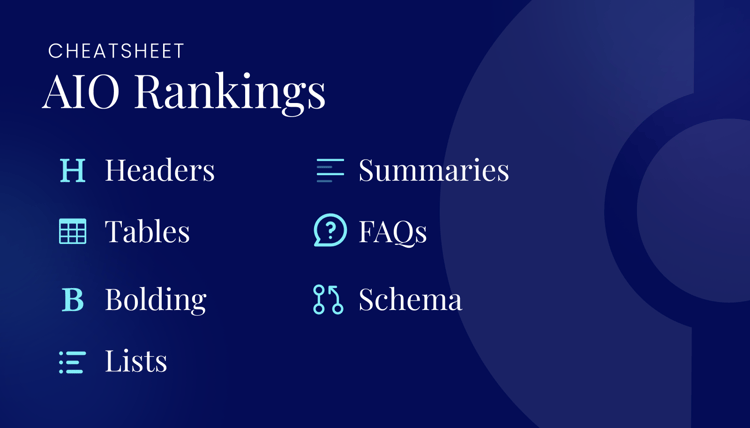
One of our healthcare manufacturing clients illustrates this shift. When Kuno analyzed the data from their product pages, our team found structural gaps that limited visibility in AI Overviews. The solution wasn’t more keywords, but more organization. We recommended adding new sections that addressed intent directly, such as, “How to use this product in three simple steps,” and “Who it’s for.” Those changes, along with clear explanations of use cases, helped their content rise consistently in AI summaries.
“AI systems reward clarity,” says Louis Lakatos, SEO Strategist at Kuno Creative. “Recent research confirms AI platforms favor content with a clear hierarchy, and structural cues that are easily digestible like headers, lists, tables and summaries. We were ahead of the curve, building those cues into client strategies long before Google’s AI Overviews even launched. Our AIO Rankings Cheat Sheet shows the exact structural cues that AI systems love. Our approach validates with every AIO ranking we achieve for our clients in niches ranging from software to health and industrial manufacturing."
The takeaway is simple. SEO success now depends on how we structure content as much as what it says. Schema markup, header hierarchy and direct answers to questions signal to AI that your brand is an authority worth citing. The plus is that when you make it easier for machines to understand you, you also make it easier for people to find and connect with you.
3. Using AI Data Analysis To Uncover Hidden Opportunities
Predictive analytics has become one of the most valuable tools in modern marketing. Platforms like HubSpot now use AI data models to uncover previously invisible patterns. For marketers, that means the difference between reacting to change and anticipating it.
With the right configuration, AI in HubSpot can forecast when a software customer is likely to renew, when a manufacturing client might explore a related product, or when a prospect’s engagement signals show strong buying intent. Those insights let sales and marketing teams act before the opportunity slips away.
“AI is helping us see what used to be hidden in plain sight,” says Matt Nagel, Kuno VP of Revenue Operations. “It connects the dots between behavior and timing. Instead of waiting for leads to raise their hand, we can reach out with context exactly when they’re ready to engage.”
AI gives marketers the foresight to predict consumer behavior. When your team understands what customers need before they say it, every interaction feels more thoughtful, timely and human.
4. Scalable Creativity Without Compromise
AI doesn’t replace creative thinking. It helps it go further, faster. With a well-built content marketing strategy, one strong idea can evolve across channels without losing its spark. When models train on brand data, they understand tone and intent, keeping your voice consistent as production increases.
“AI can give creative teams the freedom to focus on the story instead of the grind,” says Annie Zelm, Content Director at Kuno Creative. “It can eliminate the writer’s block that slows production so our teams can move faster without sacrificing quality.”
An AI-driven content strategy can stretch a single article into a short video, an email series, or a social campaign. Yet each version feels cohesive because the foundation is strong within the context of your messaging strategy. The bonus is that creative teams spend less time starting from scratch and more time refining the message.
Generative AI works best under human guidance. When strategy leads the process, creativity flourishes rather than slowing or diluting. The work can sharpen and become more consistent, all while still being unmistakably yours.
5. Using Custom AI for Real-Time Decision Making
Most marketing teams analyze performance after a campaign ends, missing the opportunity to respond while consumers are still interacting. HubSpot’s Data Hub changes that dynamic. It unifies data from spreadsheets and warehouses with CRM insights to show what people in your database are doing in real-time.
With these AI features, you can spot and respond to developing trends like:
- A healthcare organization might see a sudden spike in visits to educational resources, suggesting an opportunity to promote new services or outreach campaigns.
- A manufacturer might spot customers comparing related products before a renewal cycle.
- A software company might notice a pattern of users searching for help documentation, signaling churn risk or an opportunity to improve features.
Once those data points appear, you can immediately adjust your approach and see results, rather than waiting for the next report. It gives you a real opportunity to change customer outcomes that affect your bottom line.
Nagel points out, “Applying Data Hub AI in marketing workflows means we no longer measure performance in hindsight. We can see behavioral changes and use them to guide our next move. The benefit is momentum. Your team builds on what is working now and shifts gears before it wastes time or money.”
Applying AI advanced analytics to baseline data turns your strategic goals from a rearview mirror into a GPS that helps marketing decisions have a greater impact on your competitive advantage.
6. Turning Siloed Tools Into Unified Systems
Many marketing teams still juggle disconnected tools that refuse to communicate with one another. CRMs and analytics platforms often collect complex datasets, but when that data lives in silos, no one sees the whole picture. Deep customization features within AI platforms can help bridge those gaps by connecting systems through shared data and more intelligent automation.
When data scientists and developers pair their coding knowledge with AI, they can quickly create application programming interfaces (APIs) that connect siloed platforms and enable clearer data sharing across departments.
Just like in content writing, partnering with AI can remove manual bottlenecks in existing processes. A recent industry report found that 82% of developers use AI-assisted tools at least weekly and 78% report higher productivity. At the same time, nearly 45% of AI-generated code contains security flaws.
In other words, just like in marketing, these tools can't stand on their own without risk; you need an expert AI editor-in-chief to refine the output.
7. Fine Tuning Personalized Customer Journeys
Audiences expect more than a one-size-fits-all approach. They respond to the experiences that feel designed for them. AI now makes that level of personalization achievable across blogs, videos, whitepapers and even chatbots.
Through AI-powered customer journey mapping, business marketers can tailor their outreach to where each person is in the decision process. A first-time visitor might receive an introductory explainer. A loyal customer could see a curated guide or incentive aligned with past activity.
That same personalization now extends into conversational interfaces. AI-driven chat tools are learning from user behavior and tone to deliver experiences that feel intuitive and human.
“AI chat tools are no longer static widget business applications,” says Jim Van Hise, Director of Digital Experience at Kuno Creative. “They’re learning from your website, adapting to each visitor, and starting to have real conversations that feel helpful rather than scripted.”
He adds, “What’s exciting is how these systems can now adjust tone, content and even visuals as they learn more about a visitor’s intent. The bot can enhance human interactions in ways that feel genuine and personalized.”
Using these tools can build trust and deepen engagement. When customers feel seen and heard (even by a bot), loyalty naturally follows.
8. Improving Visibility In AI Overviews With Schema Markup
Think of schema markup as a way to gently guide AI and search engines to see the value of your content. It is like placing clear signposts on your website that tell Google, Bing and other search engines, “This is important, and here’s why.”
In practice, schema markup is a form of structured data added to a webpage’s code that helps search engines readily understand the meaning and context behind the information on that page. Instead of simply reading the words, AI can interpret what the content represents—such as products, reviews or events—and use that data to serve more accurate and helpful results.
Done right, schema allows your content exclusive access to high-value placements like Featured Snippets, People Also Ask boxes and AI-generated summaries. It's a simple yet powerful way to boost business visibility and ensure your brand stands out in AI-driven search.
Beyond search performance, schema markup supports broader value creation by connecting technical best practices with business goals. Structured data provides a holistic view of how your content contributes to better performance, helping teams measure progress toward their desired outcomes.
Schema may feel technical, but at its heart, it is about helping your story shine in a world where clarity and clear objectives win.
Gen AI and Google Cloud: Aligning SEO and Business Strategy for Smarter Visibility
Google no longer writes the rules on search visibility. A Bain & Company report found that 80% of consumers now rely on AI-generated summaries for at least 40% of their searches, and traditional organic traffic can drop by 15-25% when these summaries appear.
Generative AI is redefining how organizations approach SEO, blending content visibility with cloud-based intelligence to create more connected and data-driven marketing strategies. Through platforms such as Google Cloud, AI transformation becomes part of the broader business process—improving efficiency and helping teams align closely with corporate strategy.
AI-powered platforms like ChatGPT and Perplexity now influence what people find and how they interpret your brand. Like Google, these systems favor consistent and trustworthy content. When your content is clear, verifiable and consistent, it becomes easier for AI systems to interpret and share.
For marketers, our future focus is already shifting from chasing rankings to building the credibility that these systems can validate. Optimizing for AI visibility means presenting expertise that remains consistent across every channel and proving that your insights hold up under scrutiny.
It’s a delicate tripod of algorithms, authenticity and audience trust — if one leg falters, your visibility can, too.
How Kuno Creative Supports Custom AI Marketing Strategies
We believe AI in digital marketing should feel like it belongs to you, not like another tool you're forced to adapt to. That's why we design effective AI strategies that reflect your unique business strategy workflows, your prospects and existing customers, and your long-term visions for the future. We build every solution with your data, priorities and growth in mind.
At Kuno Creative, we use generative AI to make marketing more intelligent and adaptable. Our approach blends technology with strategy to help brands move faster without losing authenticity. By training AI on brand data, refining prompts and integrating tools like Google Cloud into marketing systems, we help businesses align their AI use with real outcomes. We use AI to strengthen the human side of marketing, helping teams spend less time managing tools and more time building meaningful campaigns. Most importantly, we harness these tools to build your brand voice, not tear it down.
AI is a tool you can use to win. We can show you how.


Robin Walters