





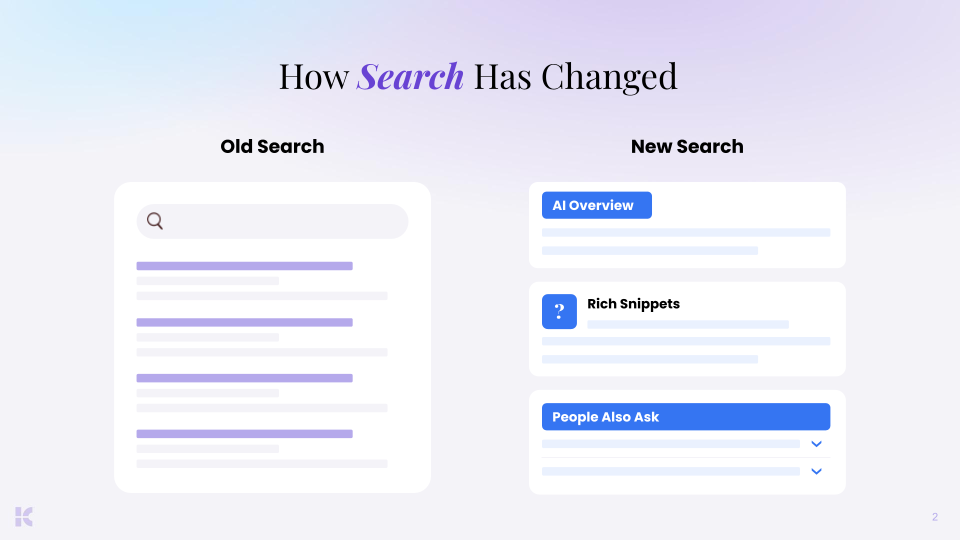
Search doesn’t work the way it used to. Type any query into Google and, as you’ve likely already noticed, the familiar blue links of organic search results are buried further down the page every passing day.
In their place, at the top of the search results, are direct answers. Generative summaries. AI overviews. Voice responses. Answer boxes. Map packs. YouTube video snippets. Audiences have to wade through a lot before they get to even the best ranking sites – if they get there at all.
To keep ahead of the curve, you need to add two layers to your strategy and go beyond just search engine optimization (SEO):
- Answer Engine Optimization (AEO), which helps you win those instant, in-SERP results like featured snippets or voice queries, and
- Generative Engine Optimization (GEO), which increases your chances of being cited inside AI-generated responses on tools that don’t even link out
Combined, these three engine optimizations create a winning strategy to build trust and relevance, even when there’s no click involved.
→ Missed our webinar, Get Found First: Combine SEO, AEO & GEO Like a Pro? Watch the replay here.
What Is AEO and GEO — And Why They Matter in the Search Landscape
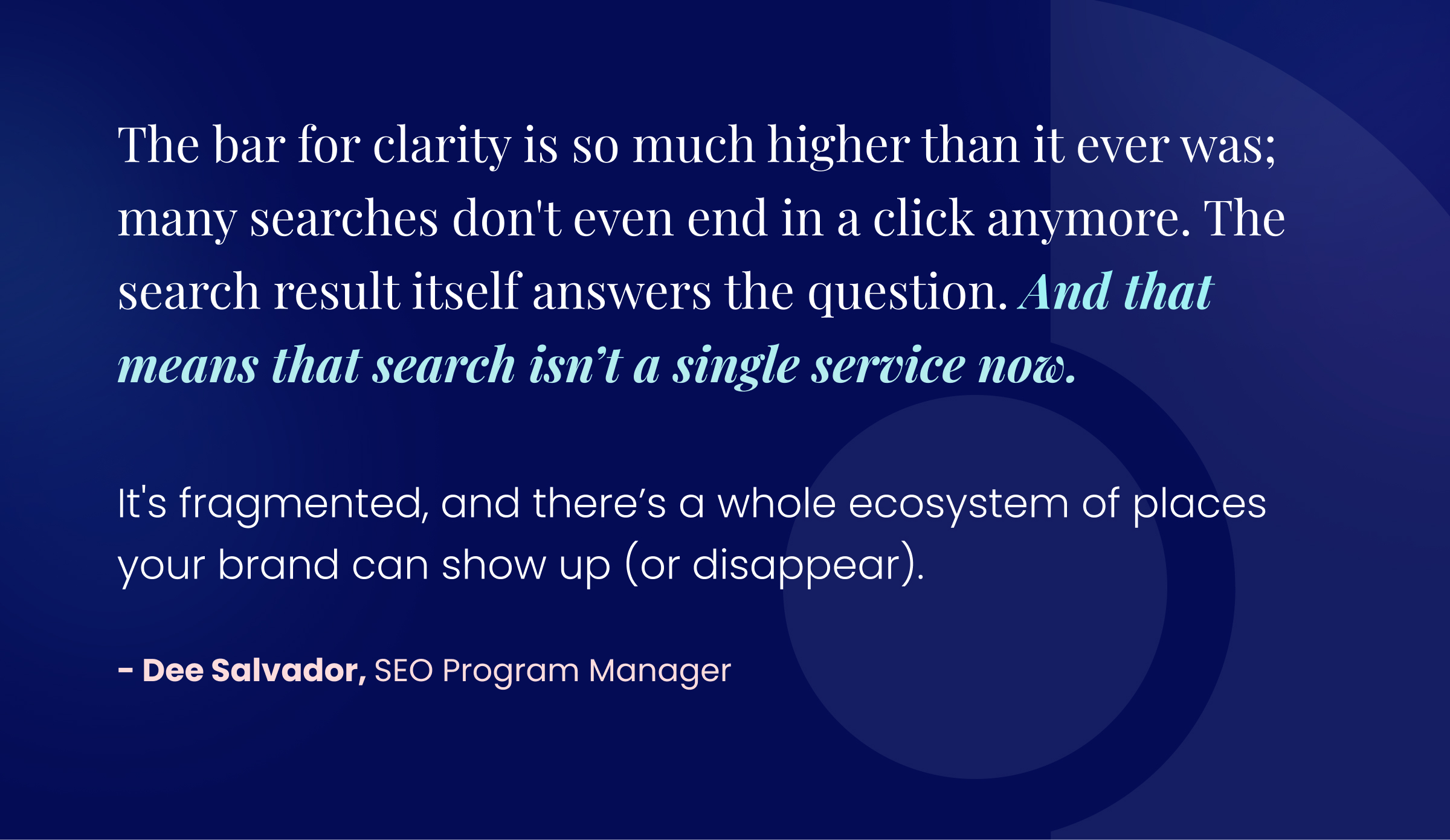
The bar for clarity is so much higher than it ever was; many searches don't even end in a click anymore. The search result itself answers the question. And that means that search isn’t a single service now. It's fragmented, and there’s a whole ecosystem of places your brand can show up (or disappear).
Traditional search engines no longer just want to point people towards answers: They want to be the answer. It’s no longer enough to rank. You also have to be selected by AI tools like Google’s AI Overviews and by AI-powered platforms like ChatGPT, Gemini or Perplexity.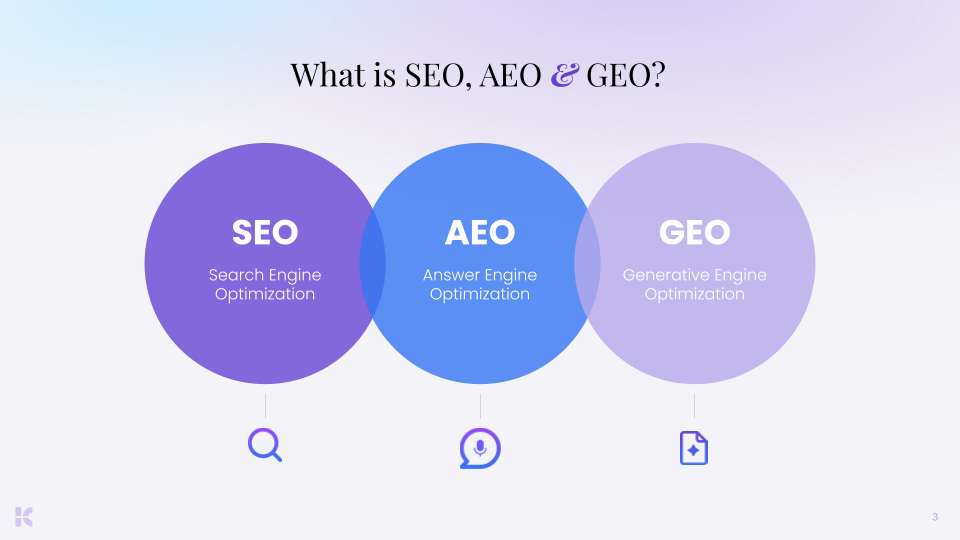
Definition of AEO (Answer Engine Optimization)
Answer Engine Optimization is all about structure and clarity. It’s what helps your content show up in featured snippets, voice search or People Also Ask results.
The goal is simple: make it as easy as possible for Google, Siri, Gemini or any other AI tool to pull a direct, accurate answer from your site and credit you for it.
For AEO, your writing has to match user intent. Be intentional about the questions you ask (and answer) on a page. Use clear headings, concise summaries and structured data that makes it easier for AI systems to recognize what you’re saying.
AEO is the layer that wins the valuable top-of-page boxes that users see before they even scroll.
Definition of GEO (Generative Engine Optimization)
GEO, on the other hand, is getting your brand mentioned in the responses AI tools create, even when they don’t link out.
That might sound like a tall order. After all, you don’t “rank” in generative engines like ChatGPT or Claude. You get cited or mentioned. Essentially, you get selected as a source when these systems pull together their answers.
→ See what getting selected looks like in practice: our AEO and GEO results.
To be selected, your brand should be consistently positioned as a trusted source that generative systems can pull into their summaries and recommendations. Brands that win here stay human-focused in their content, while making it straightforward for machines to understand and reuse the content.
With GEO, there are some factors that can move the needle:
- A strong topical footprint
- Clear connections across your website
- External credibility signals
- A steady presence across multiple platforms where AI systems tend to look for validation
SEO Is Still the Foundation
Let’s be clear: conventional SEO isn’t out the window just because search has changed. If anything, it matters more than ever because everything else sits – or doesn’t! – on top of it.
You still need the basics: crawlability, speed, site structure and strong internal linking. And, of course, content that matches user behavior and makes sense to search crawlers. Without that strong foundation, the rest of your AEO and GEO efforts won’t get very far.
Think of it as a pyramid. 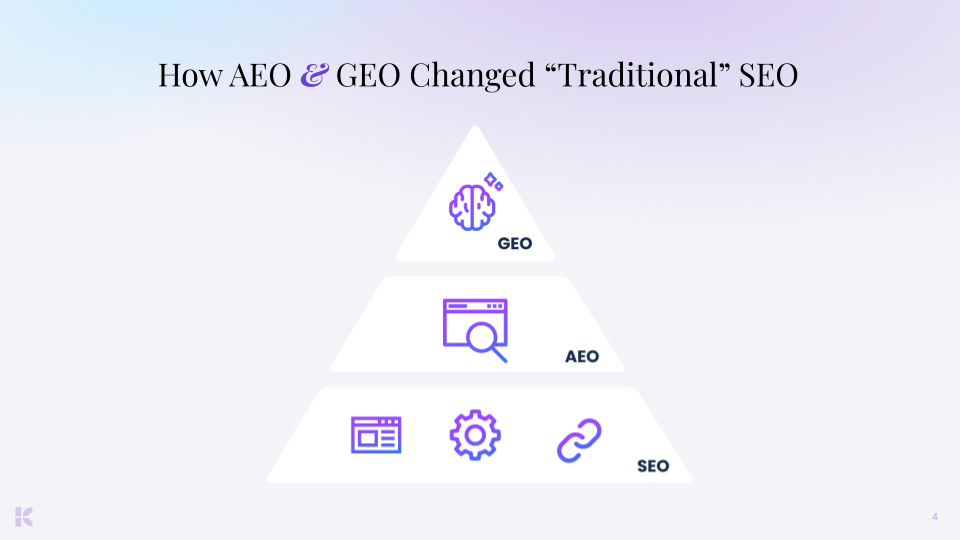
SEO, at the base of the pyramid, is always going to matter. AEO and GEO add new layers where you can win attention. The goal isn't to pick one layer, but rather to excel at all three so you have more chances to show up wherever users are seeking answers.
To recap, we’re not replacing SEO. We’re building on top of it by also optimizing for the way AI tools and search engines now present information.
Crafting Content That Ranks for AEO and GEO
AI systems don’t just stumble on great content; they scan for structure. That means you have to write for your human audience, but also for the AI machine. The cleaner your structure, the less machines have to guess and the more likely you are to be chosen as the answer.
Lead With the Question (Like: How Do I Optimize for AEO and GEO?)
Use natural language in your headers. (Like we just did in that header above.)
H2s and H3s that mirror real search results make it easy for engines to identify the question, especially when you answer it directly underneath in 40–60 words. Then, expand the answer later with more detail in your piece of content. (Yes, like this. Meta? Maybe.)
Mix Up Your Formats
Paragraphs are great, but AI loves to pull bullet points, comparison tables and bolded summaries into snippets.
Lists turn ideas into simple steps, for instance. Tables are great for pricing or comparisons because tools can pull that data cleanly.
For our purposes, here’s a summary of the differences between SEO, AEO and GEO and what it means for search.
|
SEO |
AEO |
GEO |
|
|
Goal |
Rank in search results |
Be featured in answer boxes and AI Overviews |
Be cited in AI-generated answers and summaries |
|
Format Focus |
Full pages, blogs, product pages |
Questions, direct answers, structured data |
Topic clusters, citations, entity-based content |
|
Optimization |
Technical SEO, content, links |
Headings, summaries, schema markup |
Entity building, brand mentions, consistency |
|
Key Tools |
Search Console, Semrush |
FAQ Schema, lists, tables, bolded answers |
AI visibility tools, ChatGPT tracking |
|
Measurement |
Rankings, clicks, conversions |
Snippet wins, voice mentions, zero-click CTR |
AI citations, prompt coverage, branded queries |
Add Schema Markup and Structured Data
Structured data like FAQPage, HowTo or Article schema removes the guesswork for Google. It’s code that labels your answers so machines don’t have to think twice.
E-E-A-T Signals for AEO & GEO
All search engines favor consistent, credible sources. The more signals of Experience, Expertise, Authoritativeness and Trustworthiness you can provide, the more likely your content is to be pulled into AI-generated responses.
That means authorship, citing credible sources, using real examples and writing like someone who knows the space. Show you belong in the conversation.
Connect the Dots With Internal Links
Don't let a great piece of content stand alone.
GEO in particular isn’t just about one blog post but rather how your content builds a consistent topical footprint across your site and beyond. Use topic clusters and pillar pages to reinforce your relevance and build an entity-wide view of your brand, not just a one-off ranking.
Be Fast, Mobile-Friendly and Conversational
And, of course, don’t overlook the basics.
Pages need to load fast, especially on mobile. Voice-friendly content should sound human. Use short paragraphs, contractions, natural phrasing and everything else that makes it easy for a voice assistant or AI tool to read and repurpose your content.
Measuring Success & Iterating
Traditional metrics still matter, but they no longer tell the whole story. Generative engines and AI-powered platforms are rewriting the rules of what it means to be seen, and visibility isn’t just about rankings anymore.
Key Metrics To Track
If your old SEO reports are all clicks and keyword rankings, it’s time to layer in new metrics.
- Featured snippet wins and AI Overview appearances
- AI citation frequency
- Zero-click search rate vs. clickthrough rate
- Engagement signals like scroll depth, dwell time and conversions (especially for pages built around search intent and direct questions)
- Shifts in SERP placement
Tools and Platforms
If you want better answers, start with better tracking. While tools specifically for measuring the success of GEO and AEO are still on the frontier, the tools you are likely already using can provide solid insight.
- Google Search Console helps track featured snippets, click behavior and performance across traditional and AI-enhanced SERPs.
- Platforms like Semrush, Ahrefs and Moz let you monitor SERP features, including knowledge panels, featured snippets and position zero.
- Some enterprise platforms (like Semrush Enterprise) now offer modules for tracking brand mentions and prompt-based citations in AI-generated content.
- Use structured data tools like Google’s Rich Results Test or Schema Markup Validator to make sure your FAQ schema, Article schema and other tags are working correctly behind the scenes.
Iteration & Content Refresh Strategy
You don’t need to overhaul your content library every quarter, but you do need to know what’s worth revisiting and improving. Start by identifying your highest-visibility, highest-converting pages and make tweaks to help bump performance for both AEO and GEO.
Those edits could include, for example:
- Updating stats or direct answers to match what users are asking about now
- Expanding your content with new fan-out questions that match related queries AI models are likely to generate, with short answers that can be featured at the top of search engines
- Revalidating your schema to make sure it’s accurate and compatible with generative engines
Don’t wait until search performance drop to make a move. Build in checkpoints and keep your most important pages tuned to where search (and, more importantly, your audience!) is going next.
Kuno Creative’s Role — Your Partner in the AI + Search Future
AI is still so new and changing every day. The key is to stay proactive and informed about what’s worth investing in – or work with an agency like Kuno Creative who can keep your strategy aligned with where search is heading.
We help brands evolve their search engine optimization into something much broader: a unified, future-ready approach that blends SEO with AEO and GEO. We’ve helped clients recover from traffic declines and optimize content for visibility across multiple platforms, driving real impact on their bottom line.
We’d love to help you, too. Let’s talk about what that could look like.

This post was inspired and informed by insights shared during a Kuno Creative webinar hosted by SEO Program Manager Dee Salvador.
Clare Hennig