






Like so many others, you might be feeling the pressure to deploy your own AI agent.
And on paper, the benefits seem abundant: fewer repetitive tickets for your team, faster answers for your customers and 24/7 support.
But Sinch's 2026 study, built on 2,527 senior decision makers across 10 countries and six industries, found that 74% of enterprises with an agent live in production have already rolled one back or shut it down after a governance failure.
When those agents failed, the damage landed on the support queue 35% of the time, and on the brand 34%.
Meaning that deploying an agent can have a direct, measurable, negative impact on how your customers perceive you.
The truth is, whether an AI agent is worth it depends less on if you deploy one and more on how. And that starts with knowing when an agent is the right call, and when it isn't.
Why AI Agent Projects Fail
In June 2025, Gartner predicted that more than 40% of agentic AI projects will be canceled by the end of 2027, due to escalating costs, unclear business value and inadequate risk controls.
The model itself usually isn't the weak link. Give it a well-scoped task, it delivers. And when agent projects stall, the problem usually traces back to planning.
Maybe the team rushed to launch because a competitor announced an agent first, and no one paused to define what success would look like. Maybe they pointed the agent at a messy, undocumented process and expected it to just sort things out. Or maybe they built an agent for a job a simple automation could have handled, then watched costs climb with little to show for it.
These are strategic failures, not technical ones.
Which means the fix is strategic, too. Treating agent deployment as an AI strategy question gives your agent a far, far better chance of earning its keep.
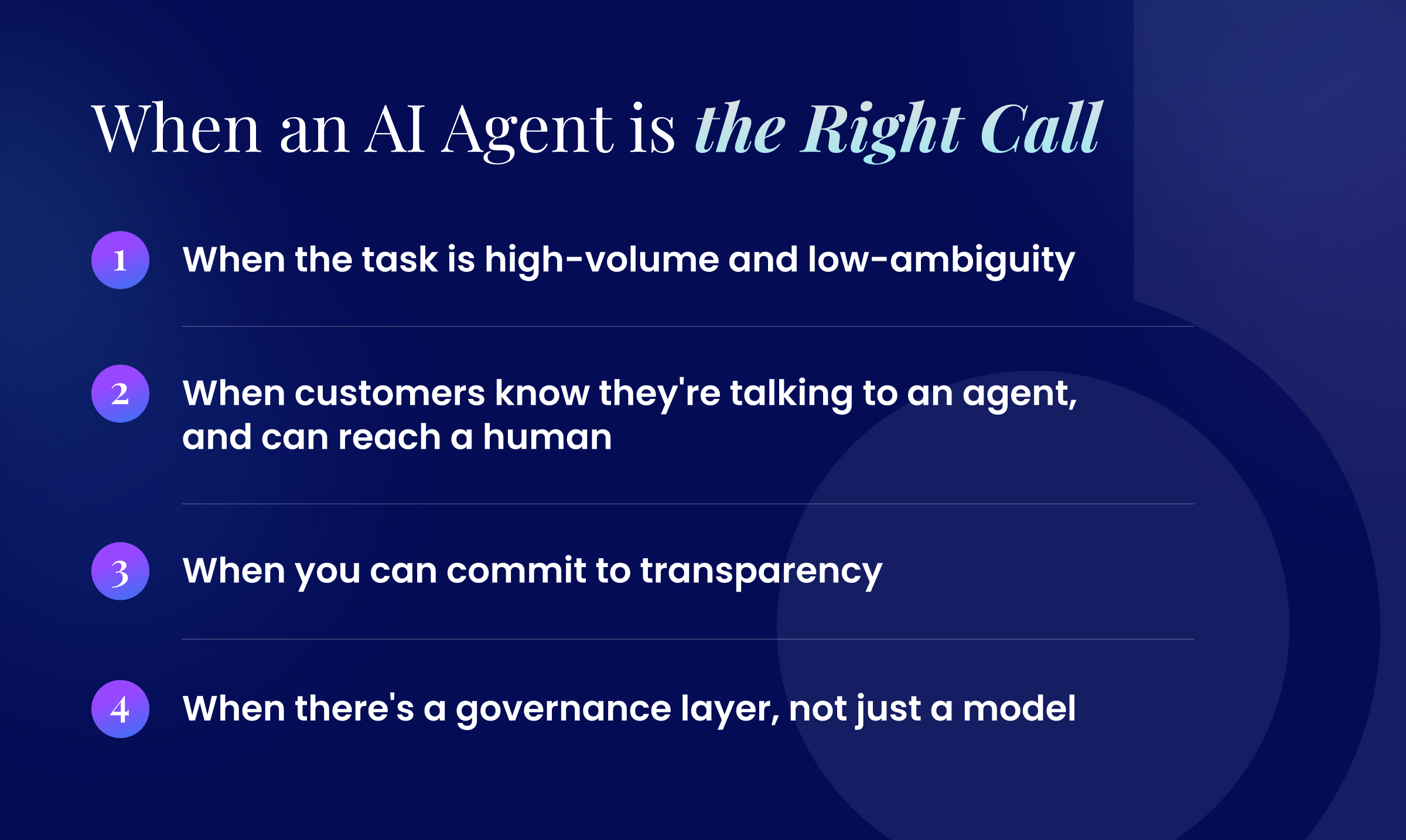
When Is an AI Agent the Right Call?
1. When the task is high-volume and low-ambiguity
Order status checks, account lookups, password resets. These requests come in constantly, rarely need judgment and can be handled quickly.
A good rule of thumb: the action should be repeatable, well documented, reversible and low stakes.
2. When customers know they're talking to an agent, and can reach a human
It seems simple enough, but many brands overestimate themselves. Twilio's research found that 81% of brands say their AI agents identify themselves immediately, but only 22% of consumers report experiencing that.
3. When you can commit to transparency
75% of customers want to know when they're talking to AI, and 95% expect it to explain the decisions it makes.
Neither is a big ask, but saying you're transparent and being transparent are two different things. Most agents fail at explanations because they’re built to produce an answer rather than account for it.
4. When there's a governance layer, not just a model
Sinch found that 84% of AI engineering teams spend at least half their time building and maintaining guardrails.
In doing so, they set the boundaries of what an agent can promise, flag the conversations it shouldn't be handling and catch the wrong answer before it reaches a customer. Which is why the teams spending their time on guardrails are the ones who'll still have an agent running next year.
An AI Agent Is Not the Right Call When…
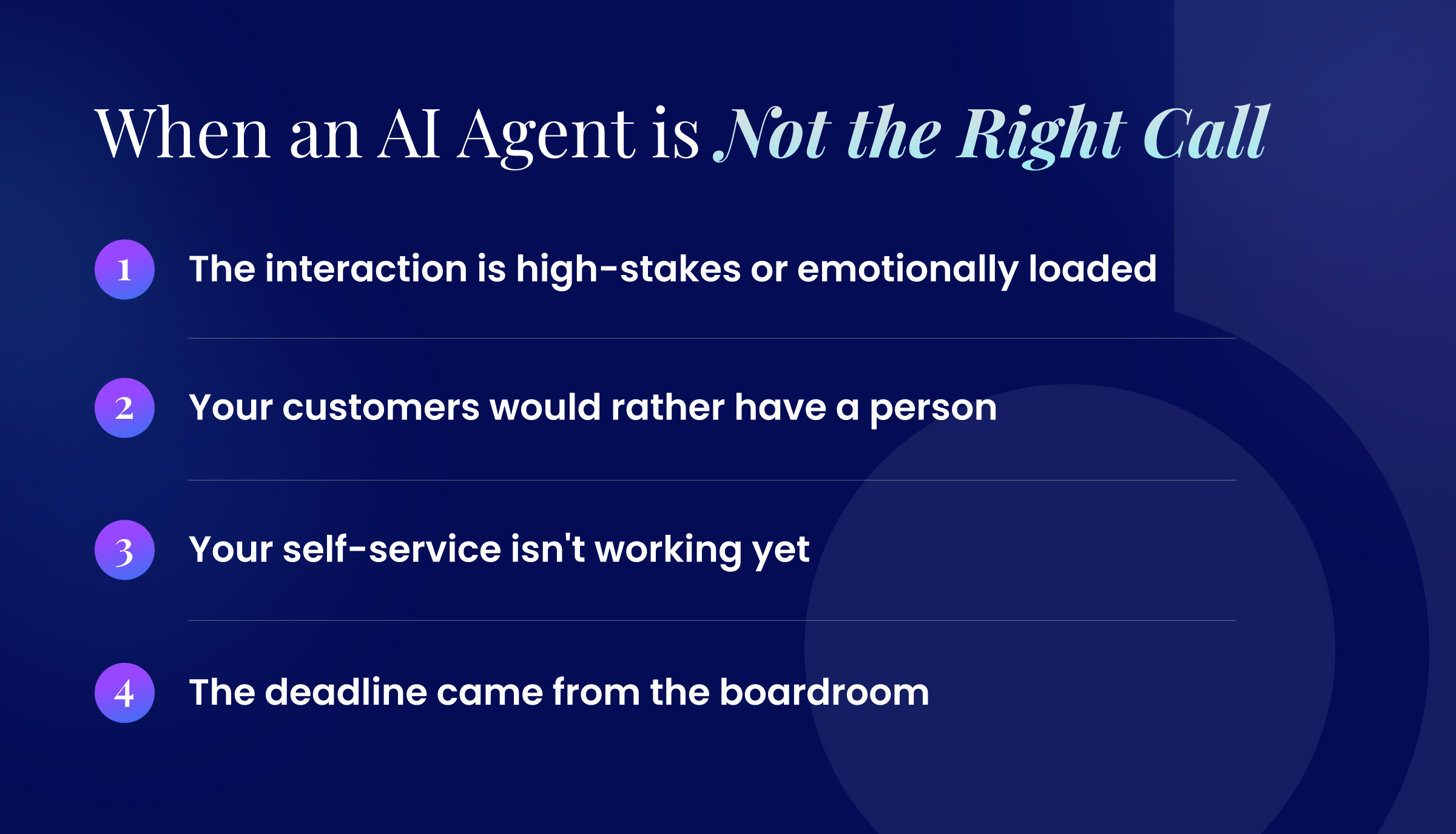
1. The interaction is high-stakes or emotionally loaded
You own everything your agent says, and a confident wrong answer can do serious damage.
In Moffatt v. Air Canada, 2024 BCCRT 149, British Columbia's Civil Resolution Tribunal found the airline liable for negligent misrepresentation after its chatbot told a grieving customer he could claim a bereavement fare retroactively, when he couldn't.
Air Canada's defense was that the chatbot was "a separate legal entity that is responsible for its own actions," but seeing as the chatbot sat on Air Canada's website, Air Canada was fully responsible for what it told customers.
2. Your customers would rather have a person
Sometimes the problem is simply that your customers don't want an agent.
HubSpot and SurveyMonkey surveyed 15,000 consumers across seven markets and found that 82% prefer human support, even when AI delivers the same outcome just as fast.
The same research found that 28% of consumers stopped buying from a brand because of how it used AI. Only a quarter like or love AI in service interactions, while 53% actively dislike or hate it.
3. Your self-service isn't working yet
An agent is only as good as the knowledge it draws from. Deploy one on top of outdated help articles and scattered documentation, and you're automating your self-service problem rather than fixing it.
A Gartner survey of 5,728 customers found that only 14% of service issues are fully resolved in self-service. Even for issues customers described as very simple, that number only reached 36%.
Fix the foundation first, then build on it.
4. The deadline came from the boardroom
Gartner surveyed 321 customer service leaders in October 2025 and found that 91% were under executive pressure to implement AI in 2026.
That pressure is understandable, but it isn't a strategy.
When the deadline comes from leadership rather than a customer problem, scoping, escalation design and governance are usually the first things to get squeezed.
The Revenue Cost of Getting Your AI Agent Wrong
An AI agent can be a genuine win for your team and your customers, but it can also be an expensive mistake.
Qualtrics XM Institute surveyed more than 20,000 consumers across 14 countries for its 2026 Consumer Experience Trends Report. They found that 34% of consumers cut their spending after a bad experience and 13% stop entirely, which Qualtrics estimates puts nearly $3 trillion in global sales at risk.
Not only that, but nearly one in five who used AI for customer service felt no benefit whatsoever. And fewer than one in three even bother to complain first.
Forrester expects a third of companies to damage their customer experience in 2026 through genAI chatbots deployed prematurely.
What makes a poor deployment so costly is that customers don't separate your agent from your brand; to them, it is your brand, along with your credibility and your reputation. A frustrating agent often reads as sloppy, and it tells your customers exactly how much you value their time.
Five Questions To Ask Before You Deploy an AI Agent
Before you scope a single prompt, run through these strategy questions to help you decide whether you should build an AI agent.
Does this question have the same answer every time?
If the right answer depends on who's asking, it needs a person.
What happens if the agent gets it wrong?
A wrong answer about store hours is a bit annoying, but a wrong answer about a refund or a medical question is something else entirely.
Can customers reach a human easily?
And when they do, does that person already know what's going on? If your customer has to explain everything twice, you haven't built a shortcut.
Is anyone watching what the agent does?
Gartner coined the term "agent washing" for vendors rebranding old chatbots as agentic AI. So it's worth asking what you're buying and who's checking its work.
Why are you building this?
There's a difference between solving a problem and having something to show at the next board meeting.
Your agent is one more channel where customers decide whether to trust you. Treat it like the rest of your brand experience.
The Takeaway: An AI Agent Is a Brand Decision
Out of the 74% of enterprises that rolled back or shut down their agent, the main problem was they weren’t strategic in their planning.
When the stakes are so high that a poor build affects the way your customers see your brand, ask yourself: should this specific interaction be automated? And have you built the transparency, escalation and governance to do it responsibly?
If the answer is yes, an agent will earn its place and be a genuine asset. If either answer is no, the most valuable thing you can do is wait, fix what's missing and build something your customers want to use.
Because at the end of the day, the goal is always to serve your customers better.
May Johnson