






Getting cited in AI Overviews and conversational AI platforms like ChatGPT is now one of the most direct ways to be considered by buyers who are researching solutions. According to the latest report from SparkToro, citing Similarweb, 68% of Google searches now end without a single click, up from 60% two years ago.
Much of this shift is driven by AI Overviews.
Buyers, especially in B2B, decide which vendors to put on their shortlist before they click anywhere, and if you’re not appearing in these AI-generated summaries, you’re not even in the running.
That's why being cited in AI Overviews and earning mentions or direct citations within large chat platforms deserves the same strategic attention you're giving to paid media and lead generation. Kuno’s AI search engine optimization services help brands improve their visibility across AI Overviews, ChatGPT, Perplexity and other AI-powered search experiences. Being cited requires going beyond creating authoritative content that educates your buyers. Now you have to think of the many questions they could ask about any given topic and cover them comprehensively, but concisely.
It’s a tricky balance and there are no guarantees, but as we’ve seen with many of our clients, it’s possible if you put in the work. We’ll share our best research-based recommendations on how to get there.
How Have AI Overviews Changed Organic Search?
If you've watched your organic traffic slide over the past year while your keyword rankings stayed roughly the same, you’re not alone.
While AI search is still a small percentage of the search landscape compared to Google, driving less than 1% of traffic even to software companies’ websites, it’s up 527% year over year, according to Search Engine Land.
Search engine optimization has evolved into answer engine optimization (AEO) and generative engine optimization (GEO), which means you’re no longer writing just for people and Google. Now, instead of writing to rank in search engines, you’re writing to be retrieved by large language models.
While many of the on-page best practices overlap, they’re not the same. Just covering SEO foundations isn’t enough anymore.
Here's what that tends to look like in Google Search Console for brands we work with: impressions holding steady or rising, because content is still being surfaced in AI summaries, while clickthrough rates fall. The content is present, it's just not getting credit in the form of a visit.
Publishing more content that targets more keywords won’t necessarily solve the problem if the content isn’t valuable or if it isn’t structured well.
How Do B2B Pages Get Cited in AI Overviews?
Traditional SEO asked, ‘Can search engines find and rank this page?’
AI SEO asks, ‘Can large language models extract a trustworthy, coherent answer from this content?’
LLMs like the ones powering Google's AI Overviews, ChatGPT and Perplexity don't rank pages the way Google's traditional algorithm does. They retrieve content based on how clearly it answers a question, how factually dense it is, whether it's structured in a way machines can parse and whether the brand behind it appears consistently across platforms AI systems treat as credible sources.
Getting found is no longer about ranking for specific keywords. It's about being retrieved, mentioned, cited and trusted by AI systems.
An Ahrefs study of 75,000 brands found the top three factors most often correlated with appearing in AI overviews were:
- Branded web mentions
- Branded anchors
- Branded search volume
These are all factors you don’t necessarily control, but they can be influenced. Getting mentions comes down to looking for opportunities to be interviewed or featured in publications, getting as many reviews as possible, and being active on social platforms.
As you look for these opportunities, make sure you’re using links that feature your brand’s name instead of defaulting to “Contact us” or “Learn more.”
The research showed these branded mentions are more important than your domain authority or the number of domains linking to you, although that’s still a factor.
On the surface, these factors influencing AI visibility might seem discouraging because they’re not just about following a formula. The emphasis on mentions can make it harder for smaller or newer companies to stand out.
But if you’re providing a great product or service and pushing for reviews and testimonials, you can make an impact.
What Makes Content Worth Mentioning and Citing?
Although there’s a lot to consider when it comes to structuring posts for large language models, the first point is to create something worth citing.
A page can be perfectly structured, but if it’s generic and doesn’t add to the conversation, it won’t send the signals that tell AI engines it’s valuable.
So write for people first.
A Semrush study of 42,000 blog posts found that content classified as human-written was eight times more likely to hold the top position in Google than content classified as AI-generated. Pages at the top of search engine results pages had an 80.5% probability of being human-written, compared to just 10% for AI-generated content. Rankings aren’t the only factor when it comes to being found in AI overviews or AI citations, but they’re still important.
LLMs are looking for content that answers specific questions with authority. A primarily AI-generated article lacks opinions and original sources.
Here are a few tips to create content that appeals to both people and answer engines:
- Aim to write something that can only come from you. Be aware of what your ideal customers are looking for and how they search, but go a step further and think about what makes your offering unique. Bring in a subject matter expert to go deeper on the topic than your competitors have or find a less obvious angle.
- Include quotes and real stories wherever possible. These supporting pieces add credibility and make your content more trustworthy.
- Break up the page. Embed videos, images, graphs or charts when you can. LLMs can scan the meta details of these shorter elements, like your video descriptions, and may pull them out for citations.
- Diversify your content ecosystem. AI systems pull from a wide range of platforms besides your website. According to OtterlyAI's analysis of more than 100 million AI citation instances, Reddit and YouTube account for 78.2% of all social media citations in AI search.
Reddit is now the No. 1 most-cited website in Google AI Overviews, with Quora following behind it, according to Semrush data.
These sites perform so well because they’re built on answering highly specific questions, and with answers ranked by their community. They’re not always accurate, but users’ up- and down-votes send clear signals to LLMs.
If you want to make these platforms part of your AI SEO plan, commit to participating like a member of the community. That means identifying the subreddits or questions where your prospective buyers are having conversations, contributing answers like a real person (not a marketer) and building up your account's karma over time by staying consistent.
YouTube is the second most-cited social media source in AI search, followed by LinkedIn, according to the OtterlyAI study mentioned above.
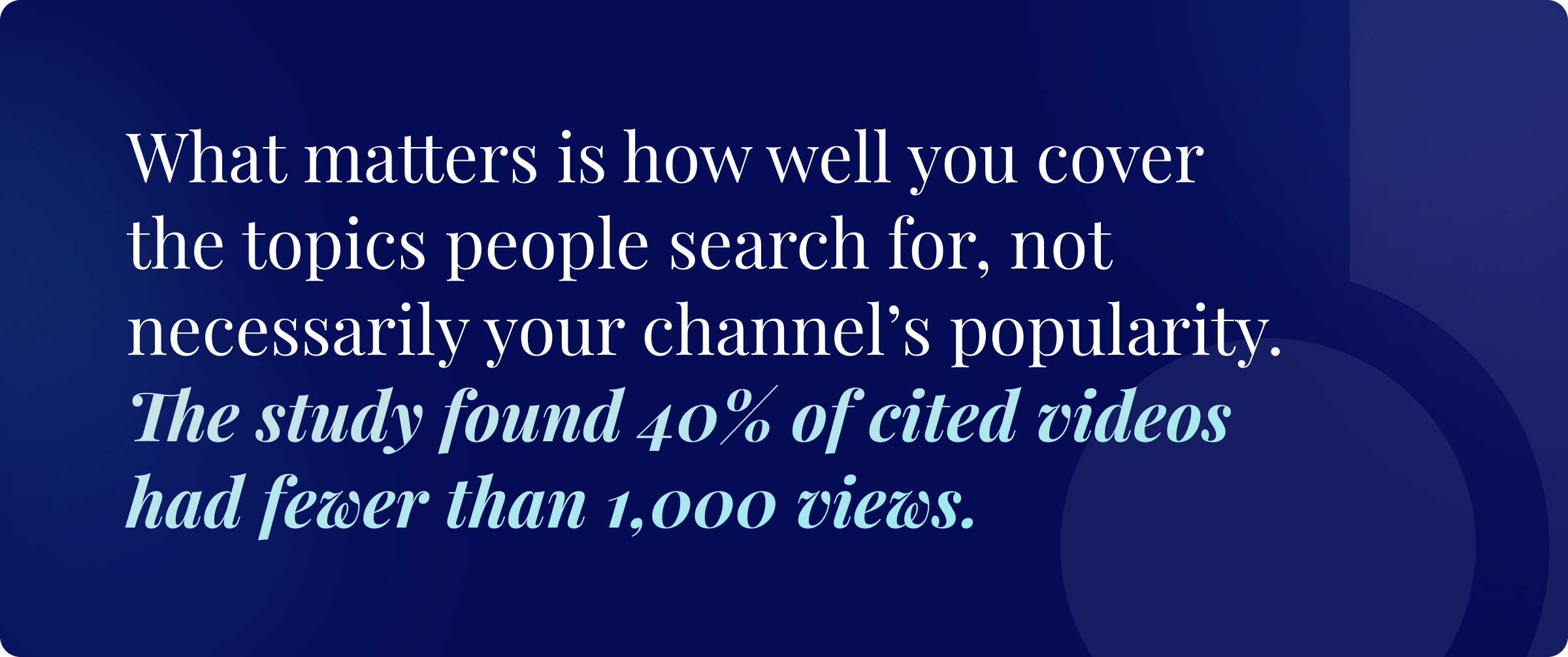
What matters is how well you cover the topics people search for, not necessarily your channel’s popularity. The study found 40% of cited videos had fewer than 1,000 views.
While short videos are great for social channels, it’s worth considering that 94% of AI citations go to long-form YouTube videos.
Write detailed descriptions too that are optimized for search and extraction. That means writing a short summary at the top and having clear, self-contained statements that answer common questions.
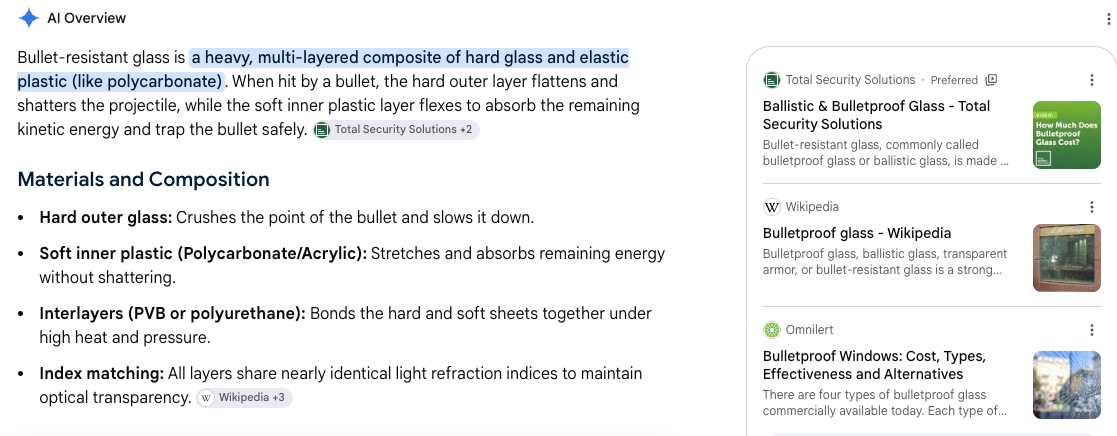
For instance, take a look at how we structured the description for a YouTube video about bulletproof glass for one of our clients, Total Security Solutions.
The description is 450 words long and almost reads like a short article. This is one of many updates we’ve made to increase the brand’s visibility in AI overviews and get them more AI citations, and it’s working. You can see they’re now listed at the top of the overview, with the video featured to the right.
Structuring Content That AI Systems Will Cite
Now let’s talk about the ‘structuring for AI’” part. This might feel less natural and even repetitive, but it’s important because large language models don’t work like traditional search engines.
As our SEO team likes to say, LLMs are ‘chaos engines.’
The same person could type in the same prompt five times and get five different answers, so you have to dig deeper to cover the many related prompts or questions someone might have.
These are known as “fan-out queries”. While there are some free and paid tools that can help you identify fan-out queries, most only focus on one LLM. Our team recommends looking at them across multiple models to get a comprehensive picture.
Here’s an example of how these look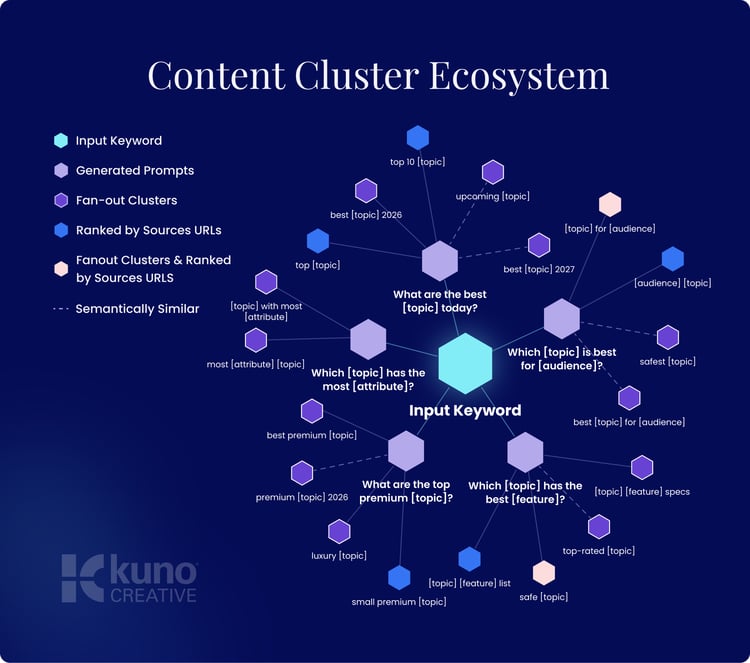
From there, focus on what you can control: the way you structure your pages. Here are our top tips:
Lead With the Answer, Then Earn the Read
LLMs look for quick answers. If your content buries the answer to a question after two paragraphs of a backstory, they’ll have to work harder and might move on.
Write like you're answering first and explaining second. For any page or post targeting a specific query, put the most direct, complete answer in the first 40–60 words after the question is posed.
Use Headers, Lists and Tables
Structure your page in a way that’s easy to understand, with a clear header tagged as a H1 at the top, followed by H2s and H3s.
Aim for short paragraphs and bulleted lists, charts or tables whenever possible to help models readily understand what you’re covering.
Write Self-Contained Sentences With Clear Facts
Instead of writing vague sentences about how you improve efficiency, use clear, verifiable claims or statistics.
Every claim should stand on its own, with a named source or a specific result attached to it. Building these data point associations trains AI systems to connect your brand with specific facts over time.
Original research reports like the Semrush study and OtterlyAI citation study referenced above are goldmines for large language models because each contains dozens, sometimes hundreds of stats and figures, and they can be updated year after year.
They’re also great for earning backlinks, as a result of people citing them over and over.
Build Topical Authority
Every post should link to a pillar page, which is usually a core product or service page on your website. This establishes topical authority and helps large language models connect the dots between what you talk about and what you do.
For one of our manufacturing clients, we found the highest-converting pages and expanded each one to rank for 100 or more keywords through deeper content, FAQ sections built from what AI models were surfacing, optimized alt text, and video.
Within weeks of relaunching one page, the number of ranking keywords for a single one of these pages more than doubled. The page went on to rank in AI Overviews and hit No. 2 in Google.
Build FAQ Sections That Mirror How AI Prompts Work
People Also Ask boxes and AI Mode's follow-up questions draw from the same idea. They're both trying to anticipate what the user asks next, and they both favor content that structures questions and answers explicitly.
Adding an FAQ section to your highest-priority pages is one of the most direct signals you can send to AI systems about the questions your content answers.
When we’ve done this for clients, we’ve seen questions and answers appearing in ChatGPT and Perplexity results. We’ve even seen ChatGPT referrals that led to new sales-qualified leads and closed deals.
Write FAQs in natural language, structured as actual questions and answers. Mirror the phrasing buyers use and keep your answers concise, just a few sentences, before linking to more in-depth content.
Add FAQ Schema/Structured Data
Schema markup is the translation layer between your website and AI systems. It makes your content machine-readable in a way that plain text doesn't: labeling FAQ sections, author credentials, article type and page topic so AI models don't have to guess at context.
Adding FAQPage schema to a Q&A section tells Google and every LLM pulling from the web: this is a question, this is the answer, this is who wrote it. Article schema with author attribution strengthens E-E-A-T signals: Experience, Expertise, Authoritativeness and Trustworthiness, all of which are weighted in both traditional ranking and AI retrieval.
Here's a basic example of what Article schema looks like:
```json
{
"@context": "https://schema.org",
"@type": "Article",
"headline": "How To Get Your Brand Cited in AI Overviews",
"author": {
"@type": "Person",
"name": "Annie Zelm",
"jobTitle": "Director of Content",
"worksFor": {"@type": "Organization", "name": "Kuno Creative"}
},
"dateModified": "2026-08-11",
"about": ["AI Overviews", "AEO", "GEO", "AI SEO", "citation optimization"]
}
```
Add schema markup to every pillar page and cluster article, not just your most-trafficked content. The goal is a consistent, machine-readable signal across your entire content ecosystem.
Include a Key Takeaways Block
Key Takeaways serve double duty. First, they help busy people scan the page and decide whether to keep reading. For AI systems, they're a pre-built, extractable summary that can be retrieved and cited.
Structure these blocks as a bulleted list with bold lead-ins and complete sentences. Put it near the top of long-form content. Make every bullet self-contained.
Earn Citations Off Your Own Website
Google's AI Overviews pull from YouTube, Reddit and LinkedIn, not just your domain. BrightEdge research, also published in Search Engine Land, found that 29.5% of all AI Overviews cite YouTube, and AI search results reference YouTube videos 200 times more often than any other video platform. That advantage holds even on ChatGPT and Perplexity, which lack an obligation to favor Google properties.
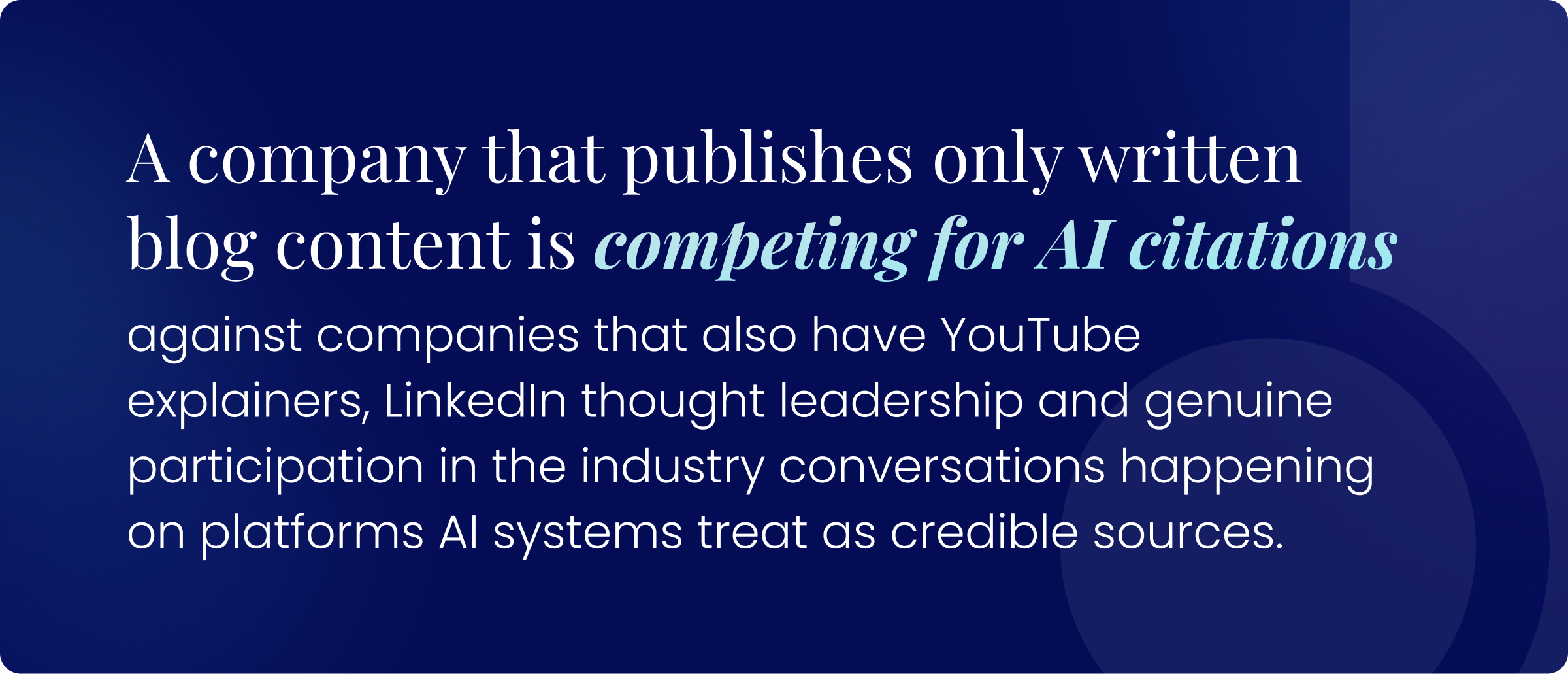
A company that publishes only written blog content is competing for AI citations against companies that also have YouTube explainers, LinkedIn thought leadership and genuine participation in the industry conversations happening on platforms AI systems treat as credible sources.
This doesn't mean you need to be everywhere at once. It means picking two or three off-site channels where your buyers are, and maintaining a consistent presence.
Does your brand have a presence on the platforms AI systems treat as credible sources for your industry? Is that content updated regularly and structured for extractability?*
The AI Citation Checklist
For any page targeting high-priority queries and seeking to optimize content for AI citations, run it against this before publishing:
Answer structure
- The H2/H3 mirrors how a buyer would phrase the search query or prompt
- The answer appears in the first 2–3 sentences beneath the heading, in plain language
- Each paragraph contains at least one specific, verifiable claim with a named source or data point attached
FAQ and schema
- The page includes an FAQ section with questions in natural buyer language
- FAQ answers are 2–4 sentences, short enough to be extracted, complete enough to be useful
- FAQPage schema is implemented and validated
- Article schema includes author name, job title and organization
- Markup has been tested in Google's Rich Results Test
Content structure
- Long-form content includes a Key Takeaways block in the first third of the post
- Key Takeaways bullets are written as standalone, self-contained claims
- Headers are specific and promise something (not "Overview" or "Introduction")
- The page is part of a topic cluster, internally linked to pillar and cluster content
Off-site signals
- Core topics have corresponding YouTube content, even short explainer
- Thought leaders at the company have LinkedIn presence covering the same subject matter
- You participate in relevant industry conversations on platforms AI systems source from, including Reddit and LinkedIn
What B2B Decision Makers Should Look For in an AI SEO Agency
Most agencies offering ‘AI SEO’ are doing one of two things: adding FAQ sections to existing pages and calling it done, or publishing AI-generated content at volume and hoping something sticks. Here’s what the most successful agencies do instead:
They measure citation frequency, not just rankings
Standard rank tracking doesn't tell you whether your brand is showing up in AI-generated summaries. An agency doing this right is running prompt-based tests across ChatGPT, Perplexity and Google AI Mode to see which queries surface your brand and which ones surface your competitors instead.
They run experiments and show you the results
AI visibility is variable. The same prompt can return different brands on different days, across different models. An agency claiming guaranteed results doesn't understand how LLM retrieval works. An agency worth hiring will show you what they tested, what changed and what they learned.
They connect visibility to your sales pipeline
Being cited in an AI Overview means nothing if you can't trace it to a conversation, a qualified lead or a closed deal. The clients we work with who've closed significant revenue from ChatGPT referrals weren't just tracking impressions, but what happened when those buyers arrived on the site and building conversion paths for people at different stages of research.
They don't treat AI SEO as a replacement for traditional SEO
Many structural signals that earn AI citations are the same signals that support organic rankings. An agency that has you abandoning one to pursue the other doesn't understand how these systems and strategies complement each other.
They think beyond your website
If the conversation is only about on-page optimization, that's a problem. YouTube, LinkedIn, Reddit and other platforms where AI systems pull citations require different content strategies and different success metrics. An agency with a real AI SEO practice has a point of view on all of them.
Kuno's AI SEO work connects content structure to technical SEO, your brand experience, and your sales.
We've seen this play out in the deals our clients close. A welding client traced a deal worth more than $119,000 directly to a ChatGPT referral. A safety device company closed $260,000 in deals from the same source. A software company serving clinical professionals landed a $250,000 deal off an AI referral.
All these buyers started by asking an AI a question, and a client of ours had the answer.
Our clients are beginning to see leads coming directly from ChatGPT, in some cases, before new content campaigns even launch. What's driving those results is the structural work: building content that AI systems can extract, trust and cite. Explore our AEO/GEO results to see how AI search visibility can translate into referrals, qualified leads and revenue.


Annie Zelm